
|
Definition and UsageThe Tip: Avoid using the Browser Support
Global AttributesThe Event AttributesThe |

How to create HTML <u> Tag
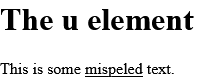
It is marked up a misspelled word with the <u> tag.
index.html
Example:
HTML
<p>This is some <u>mispeled</u> text.</p> Output should be:
How to Use CSS to style misspelled text
The u element + CSS. This is some mispeled text.
index.html
Example:
HTML
<!DOCTYPE html>
<html>
<head>
<style>
.spelling-error {
  text-decoration-line: underline;
  text-decoration-style: wavy;
  text-decoration-color: red;
}
</style>
</head>
<body>

<h1>The u element + CSS</h1>

<p>This is some <u class="spelling-error">mispeled</u> text.</p>

</body>
</html>Output should be:

How to set Default CSS Settings on HTML <u> Tag
Most browsers will display the <u> element with the following default values,
A u element is displayed like this:
Some underlined text
Change the default CSS settings to see the effect.
index.html
Example:
HTML
<!DOCTYPE html>
<html>
<head>
<style>
u {
  text-decoration: underline;
}
</style>
</head>
<body>

<p>A u element is displayed like this:</p>

<u>Some underlined text</u>

<p>Change the default CSS settings to see the effect.</p>

</body>
</html>Output should be:

| html u |
Type: | Develop |
Category: | Web Tutorial |
Sub Category: | HTML Tag |
Uploaded by: | Admin |
Read Articlehttps://develop.horje.com/learn/1434/reference